

Everyday life
Price an event without counting on a sellout
Find the price that covers costs at 24 sales. Then change the workbook to see what happens when only 20 tickets sell.
- per ticket
- $19
- tickets needed
- 20 of 24
- balance at 20 sales
- +$8
Before and after
Before
You’ve booked a $180 venue and bought 24 kits at $8 each. The $372 cost stays the same, even with empty seats.
- The $12 ticket leaves an $84 shortfall even at a sellout.
- The starting sheet uses one seat count for kit costs and ticket revenue.
- You need a price that covers the kits you already bought if four seats go empty.
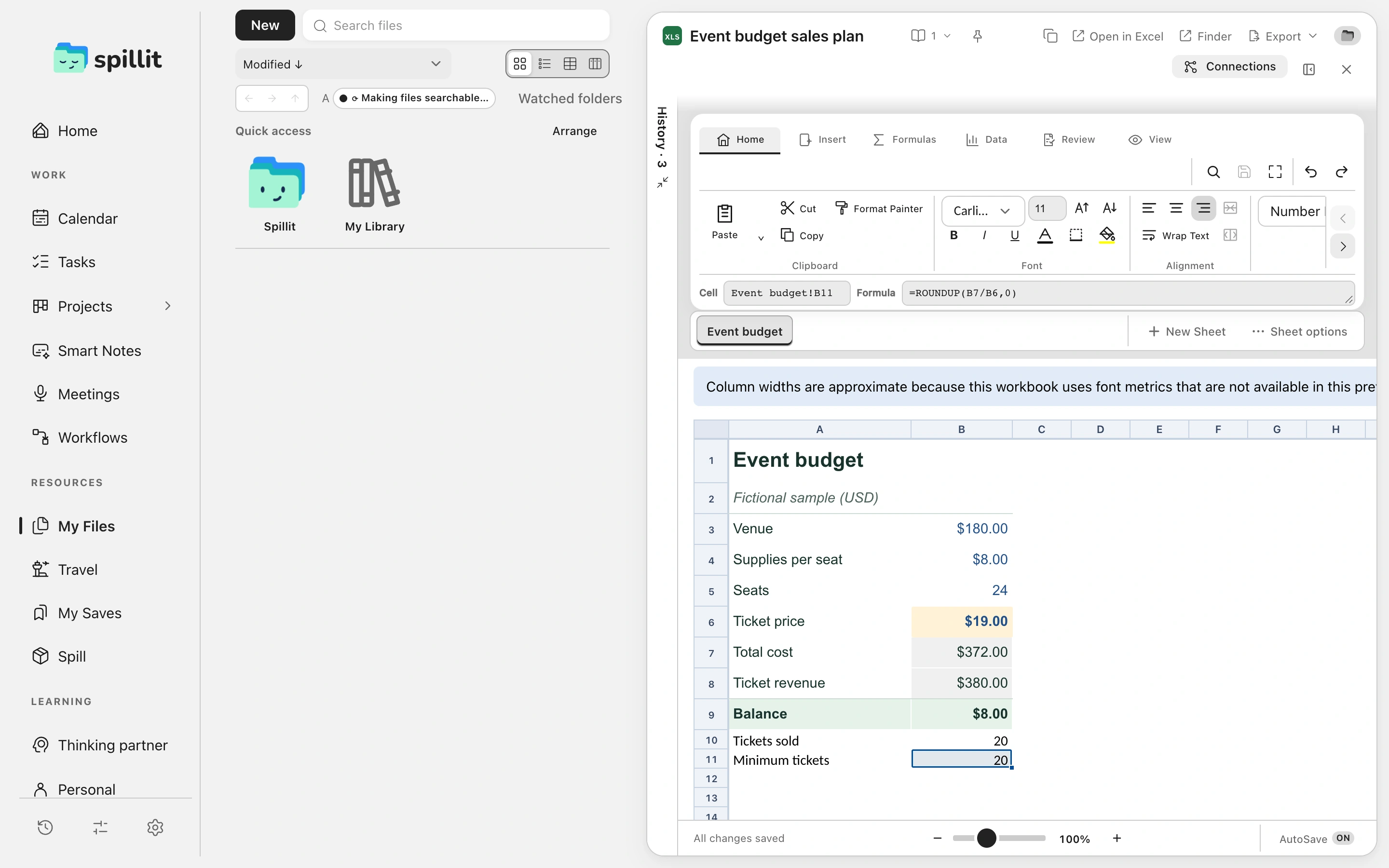
After A $19 plan that works at 20 sales
- At 20 sales, $18.60 is the price that covers the full $372 cost.
- At $19, selling 20 tickets brings in $380 and leaves $8.
- The saved workbook keeps the sales input separate and calculates the minimum tickets needed.
Start with these files
Fictional sample data for desktop Spillit.
Step by step
How Spillit solves it
- Find the full-room price
- Test 20 sales with costs fixed
- Save a price and a sales target
Keep scrolling. The screen and the guide follow you.Swipe or tap the screen, or keep scrolling.



Step 1 of 6
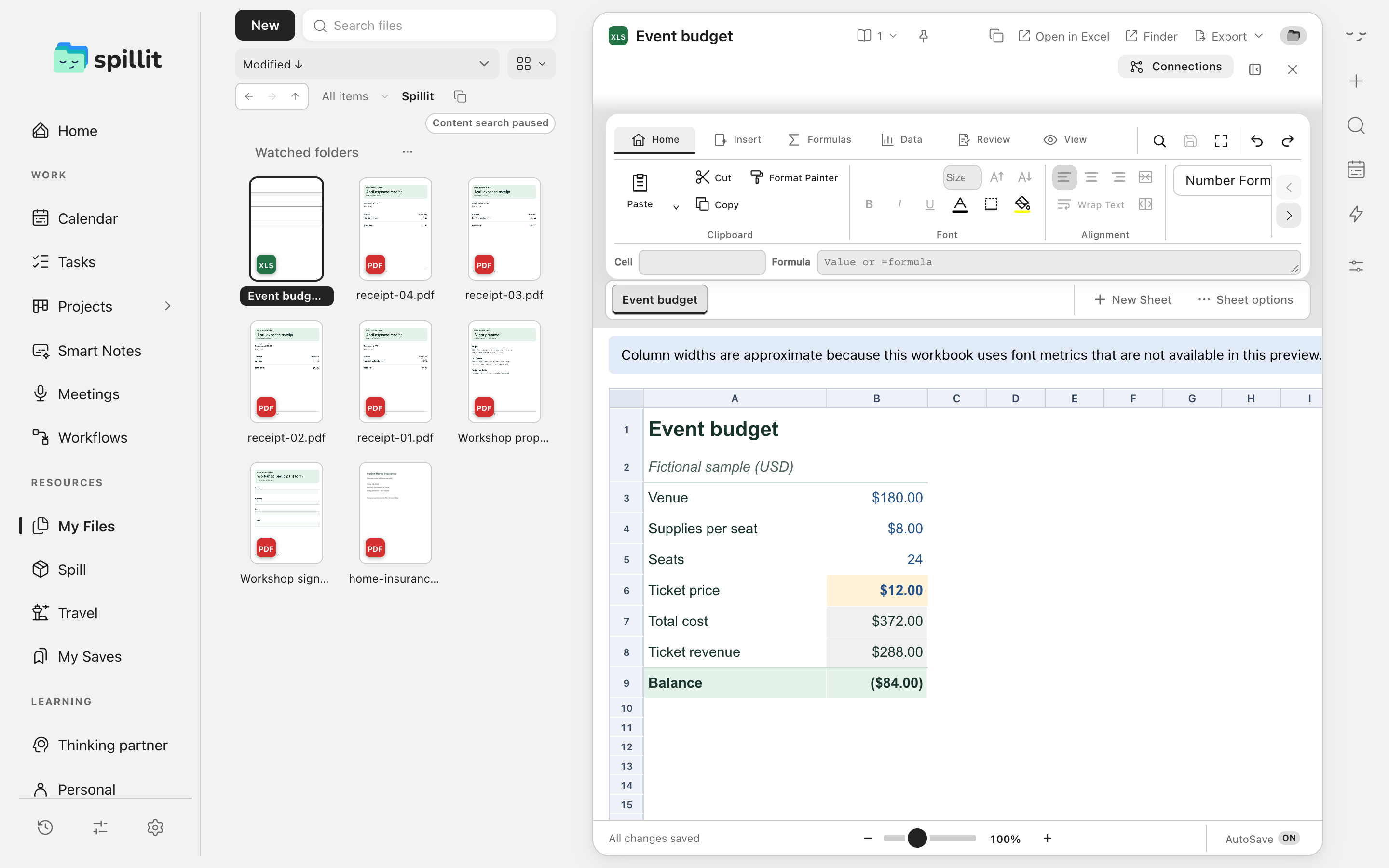
Check the starting budget
- Open: Open Event budget in My Files
- Look: At $12 per ticket, the balance is −$84
Step 2 of 6
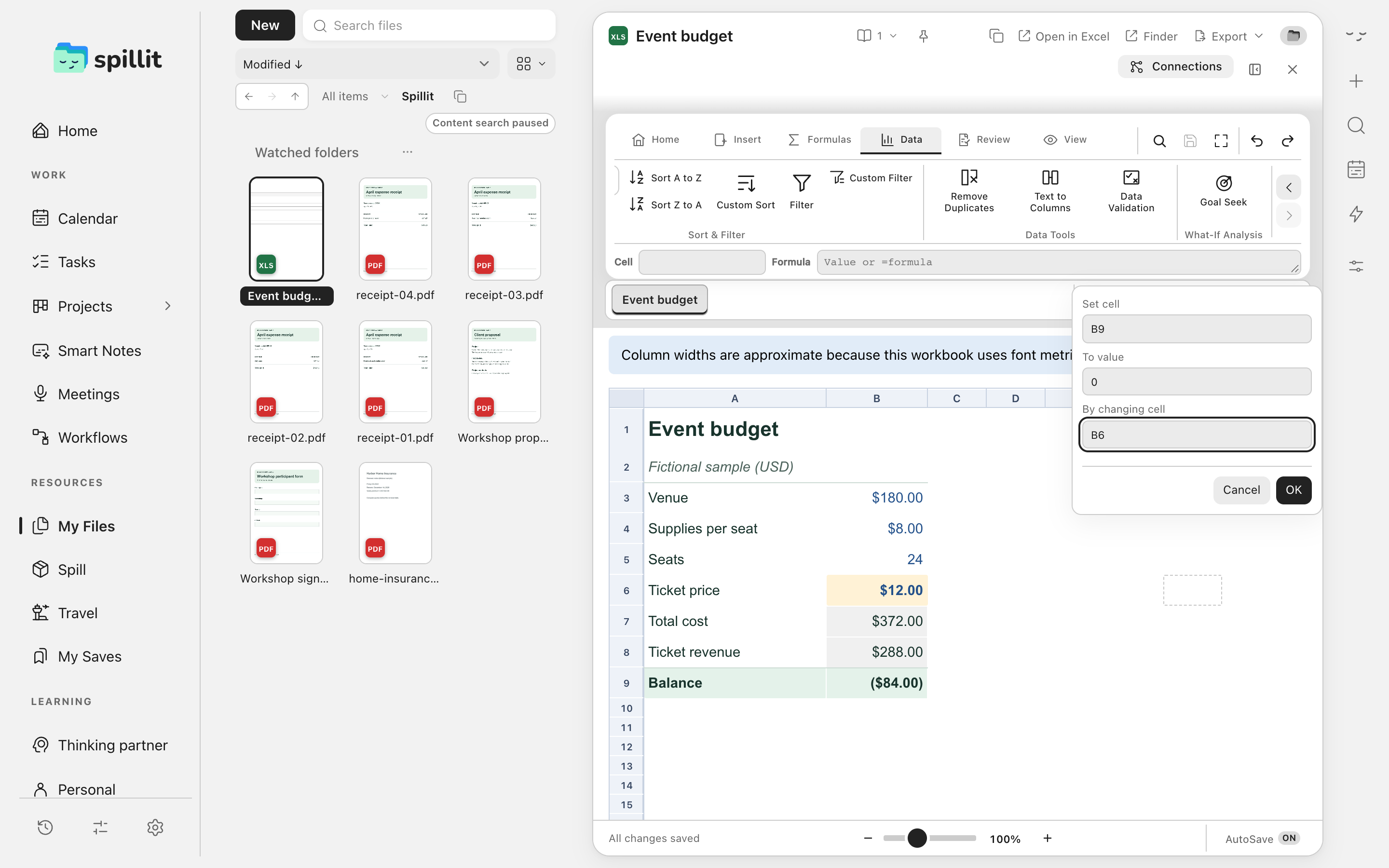
Run Goal Seek for a full room
- Click: In Data, choose Goal Seek
- Type: Set the balance B9 to 0 by changing the price B6
- Click: Choose OK
Step 3 of 6
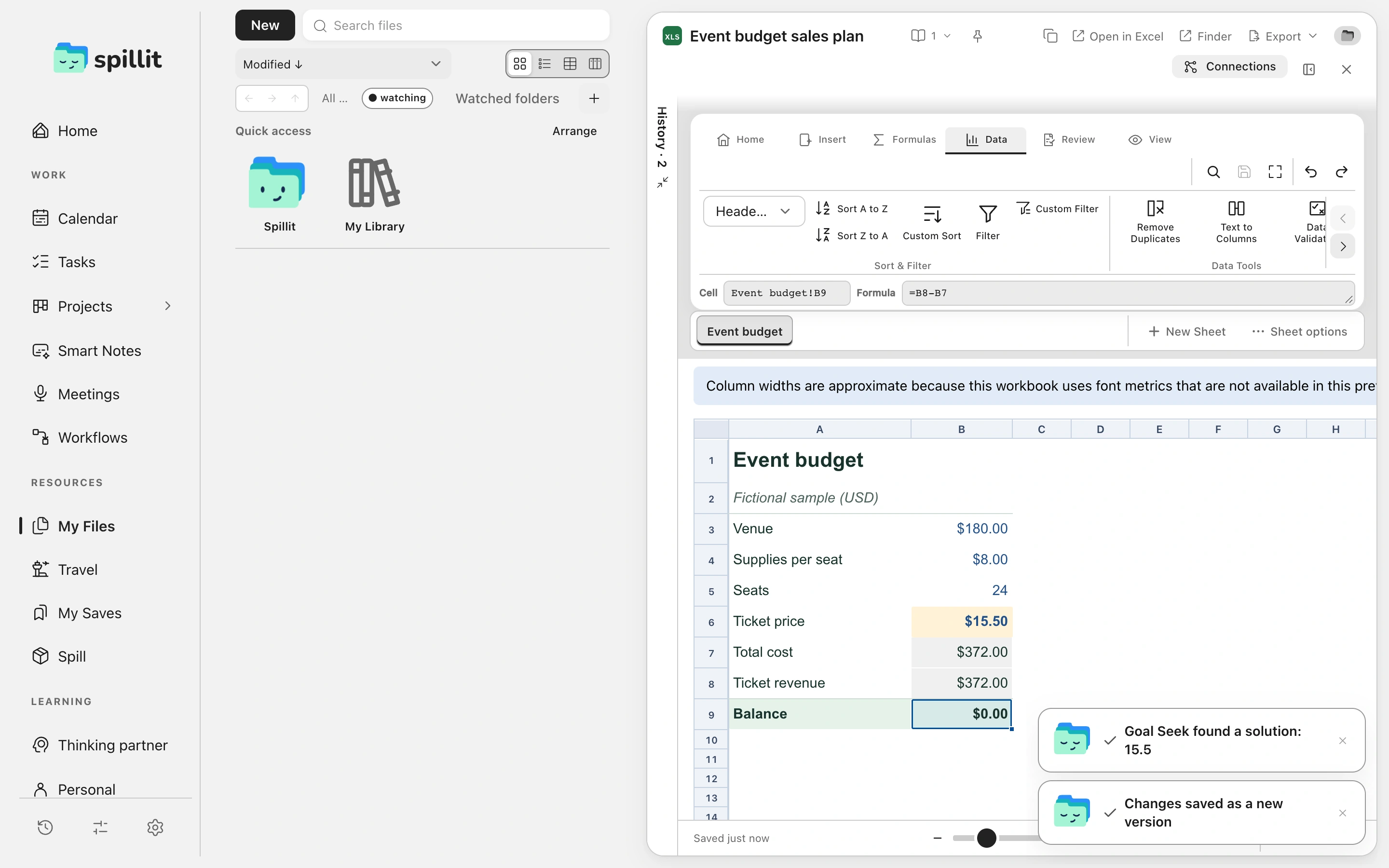
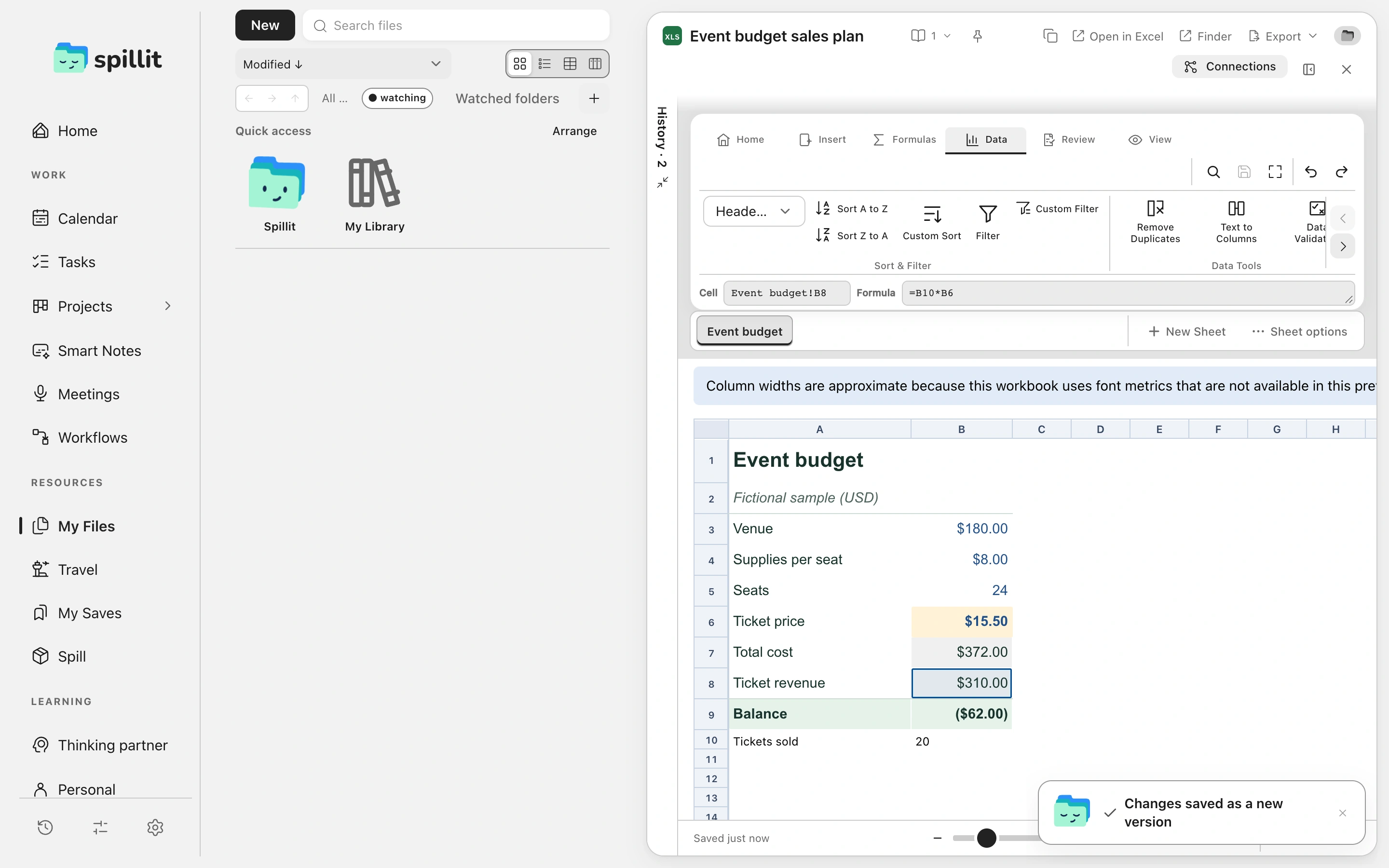
Check the price at a sellout
- Check: The price is $15.50 if all 24 tickets sell
- Look: Revenue and cost are both $372
Step 4 of 6
Test 20 sales without cutting costs
- Type: Add Tickets sold in A10 and enter 20 in B10
- Type: Set revenue B8 to =B10*B6
- Look: The same $372 cost now leaves a −$62 balance
Step 5 of 6
Find the price for 20 tickets
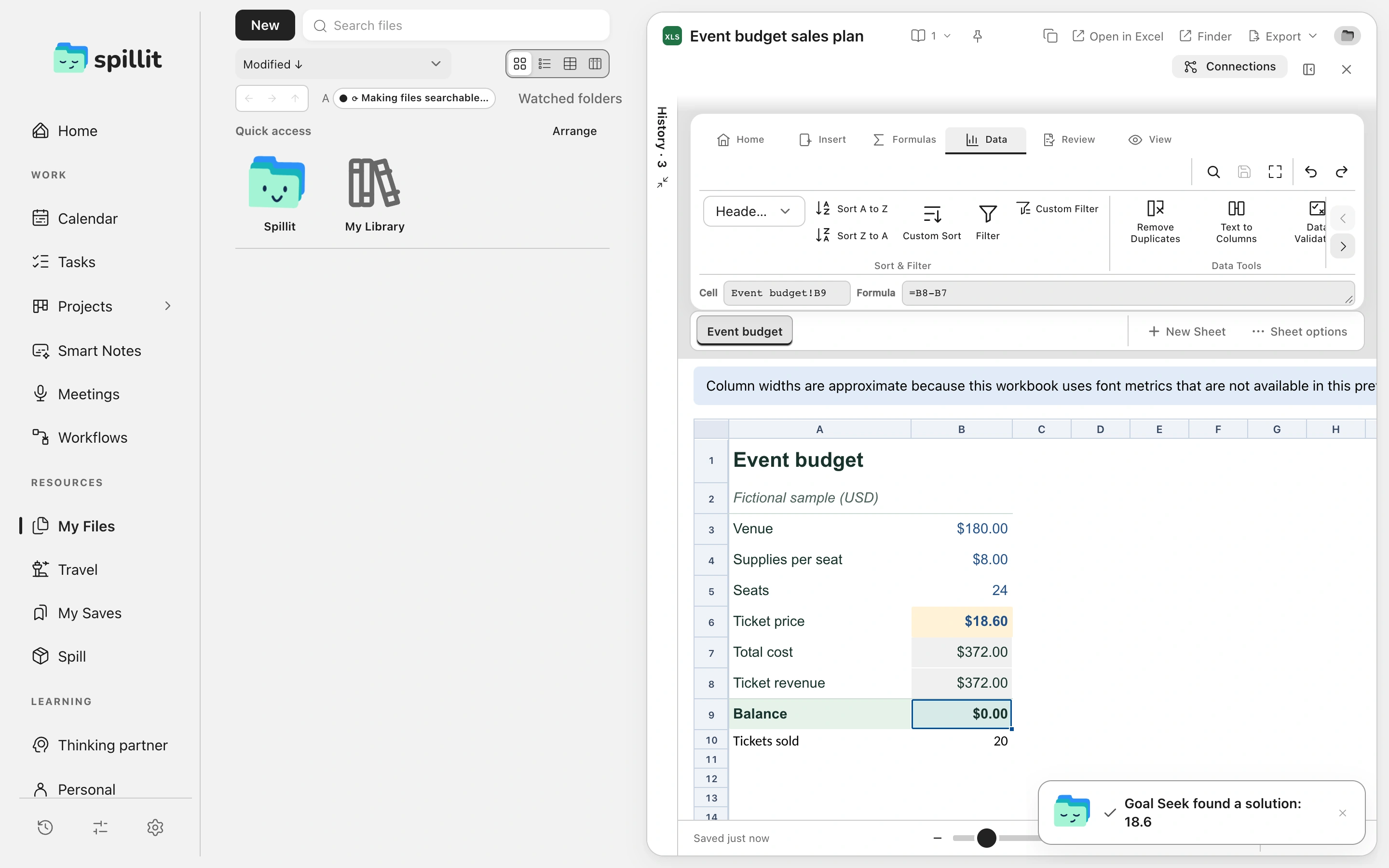
- Run: Run Goal Seek again with B9 at 0 by changing B6
- Check: At $18.60, 20 sales cover the $372 cost
Step 6 of 6
Save a $19 plan and check the sales target
- Type: Set B6 to $19 and label A11 Minimum tickets
- Type: Enter =ROUNDUP(B7/B6,0) in B11
- Check: Save and reopen. Confirm 20 tickets needed and +$8 at 20 sales.
Try the sales plan
In this website preview, the venue and 24 kits cost $372 even if fewer tickets sell.
- Revenue
- $380.00
- Balance
- +$8.00
- Minimum tickets needed
- 20
This plan covers the $372 cost.
| Tickets sold | Revenue | Balance |
|---|---|---|
| 18 | $342.00 | -$30.00 |
| 20 | $380.00 | +$8.00 |
| 24 | $456.00 | +$84.00 |